Saturday, July 10, 2010


THE FIRST WEEK IN INUKJUAK
First weeks in new communities and at new jobs can be challenging. Inukjuak was no exception. I arrived Friday afternoon, and later than expected, since I was not expected! Nobody met me at the airport, and there are no taxis here. The health centre has a driver who picks up and drops off, and in a pinch, so do nurses and other staff.
My first afternoon started at 16:00 and everyone left at 17:00. That seems to be the same all over the Northern areas. The midwives were still seeing some clients on Friday afternoon at this time, because they had three births last week, so we still doing post partums. And all visits were done in Inuktituk. It was interesting to watch, as the student midwives conducted part of each visit.
At 17:00 I was given directions back to my house...not too difficult as Inukjuak only has a population of 1700 so is quite small. I walked up the road from the health centre, past the co-op on the right, and the municipal office, also on the right, then the school was on my left and I turned right just by the church. There is only one school and only one church in this village, so that was easy. My building was the green one just down the hill from the church. It was easy. But I needed groceries, and was told that the Northern, just below (down the hill) from the Co-op had more produce and better prices. Prices were much better, on many things than Rankin Inlet. Of course I was not as far north. Transport prices depend on how far north you are, at least in Nunavik. That was not so noticeable in the Kivalliq, the region where Rankin, Coral Harbour, Repulse Bay and Arviat are located.
The weekend was a write off. I got settled, cleaned, went shopping and for a walk. I had no internet service and no TV so was a bit on my own. It worked out fine though. Read all the “Welcome to Inukjuak information and the orientation to the work here. Found out on Monday that it was almost all old and not relevant anymore!! It talked about the role of the “southern” midwife being to teach and supervise the students, plan education for the midwives and help out as necessary. By Tuesday it was very clear that I was here as a locum, and mainly to be a second midwife at births.
I was asked what my specialty was. The student who was here this week actually came and asked me to do something for her on routine lab work. The program here is totally apprenticeship, and although there is quite a lot written, doing a hand out on the routine lab work here was very useful to me. There are tests they do here routinely that I have not heard of previously. So, my computer came to work with me, and I prepared a handout of all the tests routinely done here, and why they are done.
The biggest insight for me was that the Midwives are not necessarily familiar with why they do tests, but just that they are protocols, they have been told to do them, and they do. So, the job entails being on call for births, doing the odd bit of education, and sitting on your thumbs, or doing whatever has not been done. There are three midwives here, two student midwives and they appear to do about 40 births a year.
The health centre staff work largely in French. (This is Quebec after all.) The nurses and doctors are bilingual, English and French. The Inuit are largely bilingual, English and Inuktituk. There are also clerk/translators who work the front desk and help as necessary with translation. The health centre is very friendly.
The town is small, and the Midwives said that Inukjuak has the largest population on social assistance in Nunavik. The houses all appear in relatively good condition. In this community there is no pumped water or sewage. The water and sewage trucks come to the houses every day but Sunday. (We do not do laundry on Saturday or Sunday because of this.) The water comes from up the Inukjuak River, and I am not sure how they get it here. When walking today I saw a building called the water building, and am wondering if water is actually pumped there and then delivered by the trucks. Sewage is taken daily, by small tanker truck, to the sewage lakes. It is allowed to settle there, and I understand that it goes from there to the ocean, eventually.
In orientation books it said that you need to boil the water before you drink it here. By Monday I asked the midwives if they did this for their families. No, they did not. They suggested that I might want to because my body might not be used to some bacteria they had here. I had boiled water before making tea and coffee, and had already started a routine of boiling a kettle in the evening, then moving it to the Brita in the fridge before I want to bed. That way I had boiled drinking water. What I did not realize is that the water is to be boiled for fifteen minutes before you drink it. There would be nothing left! I am now boiling water for tea and coffee, and at night boiling some for the brita. So far, I have no stomach bugs from the water.
Roads here are mostly paved. The people drive, mostly, ATV’s. These do not have to be licensed, and nobody wears helmets. There are some cars on the road, maybe one to every seven or eight ATV’s. The boats are bigger than they were in Nunavut. There are lots, and they use E-Z loaders and pull the smaller ones behind their ATV’s. Today, while walking, I watched a woman with a trailer behind her ATV, pulling camping gear and children. The average number of people on an ATV is probably 3. Although lots of people are sole drivers there are also lots with three and four people on them.
There are few dogs visible here. Apparently they all live out of town, where they will not bother anyone with their howling, and someone goes out and feeds them every day or two. I have seen no cats, and no wildlife, other than birds and bugs.
Although it can be windy here, it is nothing like the places I visited in Nunavut. There definitely are bugs, and I am using bug spray, which is not making a lot of difference. There are mosquitoes, same size as in the south, and black flies, and these tiny bugs that swarm you when you walk. It is annoying, but part of what I should have anticipated. Bugs bother the Inuit as much as they bother the southerners. Yesterday someone left the back door of the health centre open, because it was muggy. We closed all our doors, and still somehow we were swatting moszies all afternoon. Finally one of the Midwives declared that if there were two more we should close the door. It was closed about three minutes later!
The land here is beautiful. There is more definition that Rankin had. Inukjuak is on the end of a peninsula between the Inukjuak River and the Hudson’s Bay. There are Islands off the Bay side. It is not as cold as Rankin, being further south, and so has more flowers and bushes, and they grow larger. Today, while walking, I saw lupins and daisies. The daisies were 3-4 cm across, which is very large by northern standards. There was also Arctic cotton, but it was a good fifteen inches tall. The lupins were not huge, but were over a foot tall, with beautiful purple and pink colours. The only flowers that reminded me of Rankin were tiny white stars, and they are the same size, but taller. I suspect the height is due to less wind and less cold. There are also grasses, not to make a lawn, but marsh type grasses. When you look across the river you see grass green.
The weather is cool. It has been foggy for several days, rained twice and have needed my hoody and waterproof jacket two days. Two days it was also warm enough to not have on a hoody...except for the bugs. The teens and children swim in the river. One of the interesting things is an upside down sled, extended, and used as a pier. Watching some teens one day is when I realized they dislike the bugs as much as others. The swearing as they got out of the water and were trying to swat them was English. I had thought all the words myself!
I am understanding why the “southern” midwives say they use Inukjuak as a retreat. There is a hotel here, but no restaurant or coffee shop. There is no industry. The people fish, hunt and carve, or not. There are a few jobs in the Co-op, the Northern, the arena, pumping gas, sewage and water and for the municipality. There are a few jobs at the health centre and at the half way house for mental patients. Other than that, there is not much happening here, relating to work.
This village, like many Inuit villages, has a much smaller population in the summer, because the families are out on the land. Where exactly, I am not sure. Walking today, I did get to the outskirts of town, which is not far, and the roads turn to gravel and there were many ATV’s and some cars going along them. If I am lucky, maybe it will be a trip I take before I leave this little village. In the meantime I am enjoying what is here and the slow pace of the workload and friendly smiles and hellos of the people.

Wednesday, July 7, 2010

Flying used to be exciting. Sometimes it still is, but more in the destination than in the flying itself. The first three or four times I flew to Europe, there was adrenaline pumping just getting on the plane. It is not like that any more. Now it is getting organized, figuring out what I need on the plane, or what I have to take because of weight restrictions, and just doing it. Lots of waiting, in the check-in line, in the security line, at the gate, going to have ID checked, and finally, at the plane itself, waiting to get to my seat.

Still the idea of the new place is exciting, and coming to Inukjuak was no exception. Leaving Vancouver is always interesting. The mountains and ocean are beautiful, as long as you can see them before cloud cover. On this trip the cloud cover was quite low. So, it was sea, low levels of mountains, and then clouds. I had a good book, “Plain Truth” by Jodi Picoult, and was very glad. I had some snack food. Had planned to have sandwiches, but had managed to burn the cauliflower, while I was multitasking before leaving. Obviously my multitasking ability is disintegrating, or maybe it was just trying to get one too many things organized. I did have cherries.

Over the prairies the clouds dissipated somewhat, so patchy fields could be seen some of the time. Then we hit clouds again, so could see patchy lakes through northern Ontario, and haze over the Ottawa Valley. The allergy index there much have been really high on the first of July, as we could see the shimmer and colour of poor air quality. Then finally we arrived in Montreal.

The airport was much smaller than I remembered, but have only used it previously on international flights, and this was domestic. It took over half an hour for the luggage to begin to arrive, and about two thirds of it was off in another ten minutes. And then the rest of us waited. Finally it all came. However, the end zipper on my hockey bag had broken, so the whole end was open. Don’t think anything fell out, as it was wool and food, but probably will not know for sure until I realize that one specific thing is missing. Had thought that if it opened there might be wool unwinding all over the conveyor belt...now that would have been a sight.

Outside the terminal I asked somebody where the hotel shuttles came. They told me and I went to look for mine. There were two...one for the Hilton and one for another hotel. Finally I asked someone if he knew when the one to Quality Inn came by. He asked which Quality Inn? I got out my paperwork and he said that was his hotel. Turned out the sign for the Quality Inn was small and on the door of the shuttle to the Hilton. They are next door to one another. So, got my own personal shuttle to the hotel. The driver was great. He helped with the luggage, and after a tip he found me bags for the items in the pocket of the hockey bag.

I checked in, and pushed the airport style luggage carrier to my room. On the way there was a man carrying two “Coronas”. I asked where he got them, and he replied, “In the Bar of course”. Of Course. In Quebec you can carry your drinks to your room, and enjoy them there. I went to the bar, and enjoyed my corona there!!
It was now 23:30 Quebec time. I had a 05:45 wake up call as I was catching the shuttle back to the airport at 06:30. The driver had suggested that I could go at 06:00, which was appropriate for an 08:00 flight, but that if I did mind going quickly, the later shuttle would be fine. Problem was that in BC it was only 20:30. I read, watched TV and turned off the light about an hour later. And of course, nothing happened. So by 04:15 I gave up, got up and messed around in the room until the wake up call. Had morning coffee, decaf, in the room, and headed downstairs, having repacked my baggage, for 06:20.

The evening before had packed all the excess into plastic bags inside a big plastic bag. Realized in the early morning that Inuit air was not concerned about how much bags weighed. I did not have to worry about overweight the same way, and the overweight piece had been the hockey bag. I put bags of wool into my suitcase and managed to get it all in. My hockey bag looked a mess, but it was closed, and nothing would come out the middle part. (And it will be replaced before my next northern exploit).

I went to the airport, and checked in. The small misadventures occurred again. The quote I had of $6.15 per kg for overweight was to the first destination of the plane. There were four, and Inukjuak was last, so it was $13.00 per kg. Oh well. I had already decided that it was all coming. I only had 53kg, which was 23kg overweight. I did not mind. Luckily, they do not weight your carry on baggage!!
Went to the gate, and thought I would check out the one concession stand in this small part of the airport. They were very slow so did not get the yoghurt parfait, and was later very glad. Our flight was called. We walked to the plane, following the instructions to stay within the white lines. (For those of you who have not flown in small planes, they do not come to the regular gates. You go outside, rain, shine, or snow, and walk to them, and up the stairs. Usually they are also parked at the ends of the terminals, so you have to walk further to get to the gates they are at.) There was no seat designation, and I had two seats to myself the whole way to Inukjuak. I must have been giving off the “leave me alone” vibes really well.

And then the adventure began. Leaving Montreal was great, and there was lots to see as there is leaving any big city. However, clouds were probably at about 2000 feet, so once above them, it was time to read again. There is a magazine in the north called “Above and Beyond”. I think First Air actually publishes it, but they had it in Inuit Air flights. It was a particularly good issue, with an article about an elder who lived in various places in the North and about finding dinosaur bones in the Arctic.

Almost as soon as we left we were served breakfast. They offered hot or cold. The hot was eggs, so I chose the cold. It was vanilla yogurt with oranges, orange juice, a croissant with three kinds of cheese, fruit and cretons. A very nice breakfast, and was so glad that yoghurt parfait had not been purchased.
As we went over northern Quebec the cloud cover disappeared, and we could see the forest below, and many lakes. It was beautiful.

Our first stop was to be Kuujjuarapik, and it was a three hour flight there. As we were getting closer it was noticeable that there were still trees. Once we landed and could see them, they were Churchill type trees, but with greater girth. They were mostly 3-6 feet high, but quite round, as there was less wind there than in Churchill. There was also masses of water, but the rock underneath the surface was mostly red, so it was like looking down on these red lakes with tiny trees all around. When you fly in BC the trees do not seem individual, because there are so many. Flying into this village the trees all looked completely separate.

We had to refuel in Kuujjuarapik, and were told it would take 30 minutes. I got out my camera to take pictures of the trees. Went out of the terminal and put the camera on, and to my eyes to focus...battery empty. So, you will not see pictures of the little Christmas trees.

After about an hour we were to get back on the plane. I was surprised because in this airport they had security. There was nobody manning it, but there were lots of signs about what you could and could not take. Our plane only had 30 seats, so perhaps they have some larger planes and have security for those. This is the first northern town where I have seen anything about security.

We then had a thirty minute flight to Sanikilluaq. Sani, as it is affectionately known in Rankin Inlet, is actually part of Nunavut, rather than Nunavik (northern Quebec). It is on the Belcher Islands. Flying into the area was really interesting. There were small icebergs all over the area, and probably the sea ice was just breaking up. There were also patches of snow everywhere. (It was July 2nd so thought that might have all disappeared.) We did not get off the plane, and could not see much of the village from the airport.

Our third stop was thirty minutes away in Umiujaq. There were lots of snow patches going into the airport but no ice. Again we did not leave the plane.
And finally we were on to Inukjuak. I realized that I was getting excited. Lots of anticipation about what this village would be like, where I would be staying for a month. There were patches of snow, but no snow ice. The terminal was tiny and very crowded. They had a conveyor for the luggage but it was about 6 feet long so everything was taken off as it arrived. There were lots of people in this tiny space, and outside smoking. Turned out that this flight turned around and went back, and everyone had to change flights, to go further north.

My luggage finally came, but there was nobody from the health centre to pick me up. I sighed and asked at the desk, when they were less busy, for the number to the health centre. They said someone had been there, but had left. I tried to call. Kept getting the “please hang up immediately and try again later” message. Of course, it was said first in Inuktituk, then in French and thirdly in English. As the flights left, and there were only two or three of us left in the terminal I went and talked to the clerk again. I had not been calling the area code. This time I got through first time.

The health centre had been expecting me on Saturday, and not on Friday. They came to get me, dropped my luggage off at my apartment (a one bedroom, for me only), and drove me to the health centre.

Once again flying has taken me to another adventure, and another place and time. I am truly looking forward to this month in Inukjuak, with the midwives, the beautiful scenery, the lovely women, and just being North again.

Tuesday, May 11, 2010

Finally, Going to Sleep in the Igloo!!


I could not believe my good luck. After last weekend, which was the last weekend that we could arrange for me to be off call, and the blizzards that happened that week, there definitely seemed to be little chance of me going out and sleeping in the igloo. Then the Midwifery Supervisor said to me…”of course, we will try and arrange it. We can have a nurse go on call for you”. The excitement was palpable, except that after all the hype I really thought it would not happen, again.


Luckily I was wrong. Where the previous weekend, which was Easter we had planned to go on Friday, with a default on Saturday, and another on Sunday, this time, we were going Saturday after activities that needed doing. It meant not leaving until 17:00. Late, I thought.


So at 17:00 I went over to Dawn’s home. She and Leslie were coming along with Taffy, one of the dogs. Originally Dawn said we would take Mitzi as well, for our own entertainment. Mitzi is a puppy, about 6-8 months old. It would have been hilarious watching her help pull the komatik (sled), as she LOVED to pull, but had no idea about anything except playing with other dogs. However, she was having her first heat, so that would not work with the other dogs, many of whom were still male.


Dawn and Leslie had everything packed, so we moved it all (food, clothing, rifle, first aid kit, etc) out to the sled and the skido, which Leslie was riding, and packed it down. We then untied Taffy, said goodbye to Mitzi and Jack (another dog), and pulled the sled behind the skido to the dog lot.


The sled dogs heard us coming and were so excited. They always are. These dogs love to race or pull, depending on their strength and the length of their legs. Those with longer legs and shorter fur usually race (and are known for being less smart). Those with longer fur usually pull. We repacked everything onto the komatik and the skido (although I had unpacked the skido thinking we were all going on the komatik, and then it was repacked). The dogs were put into harnesses and then ran, or were walked to their places. Dawn ran to the back of the komatik and we were off.


We raced out of Johnson’s Cove and around the bend, then as the dogs had finished their initial burst of energy we went past Rankin, and through the skido racing area. The sun was beautiful and sun dogs were present as we rode along. Due to the blizzards that week the sea ice was quite rough. We had to watch where we were going as the komatik was up and down with the drifts. The dogs tried to go around most of them, or avoid areas with unstable drifts totally. This is one of the jobs of the lead dogs, to sort the exact route.


About two hours later, we could see a group of rocks ahead of us. It did not look like there was any way through the rocks. The skido came over and Leslie asked where the route was. As we got closer it was obvious, and, of course, the dogs knew exactly where they were going. Through the rocks and the cabin was soon visible. The igloo was built behind the cabin, so that persons going on Toomie tours could have the opportunity of staying overnight.


We arrived at about 20:00. It was beautiful. The sun was still relatively high in the sky. The sundogs were around the sun. The snow was brilliant. We tethered the dogs, except Taffy. She had free range as she was the look out. If a polar bear came nearby she would warn us, and Dawn could go out with rifle and scare them away. The rifle was strictly for protection on this trip. We then went around the cabin and down to get ice for water and check out the igloo.


It was sad. You could tell where it had been, and that it was not in good shape. Dawn put a foot on the top and it caved. It is not supposed to do that, but the sun had been so hot that it had melted. We could see the furs still in there, where we would have slept. Apparently they were well used, as the dogs, Taffy and Jack, had been loose on a previous trip and had decided to sleep on them, and bite them, and tear them apart. So, really there were bits of fur on the sleeping ledges. I took some pictures and accepted the fact that we would be sleeping in the cabin that night.


As we went back Dawn picked up a piece of ice, slung it over her shoulder and walked. A very funny sight, sort of like a caveman, with his ice over his shoulder. This though was ice from a lake that had been cut especially for water, and we would be melting it on the coleman stove. It was our water supply for the night.


We went inside. The cabin is small. It is one room, with a small loft for sleeping, which would not be good if you were claustrophobic. The ceiling was about 3 feet high above the sleeping pad, in the middle. Sleeping bags were good to 100 below 0 so we knew we would be warm. Needless to say, when we finally went to bed, we did wear hats, sweaters and long underwear, and took hot water bottles.


But first, we had to warm up. The cabin heated up remarkably quickly with the coleman stove. We started out in jackets, vests, sweaters, scarves and slowly took everything off. The water was melted, and we also had tea left in the thermos, so fortified tea was the first order. Then we had supper...rockin morrocan stew...a mix of yams and chick peas with assorted other veggies. By 21:30 it was dark. We went outside and were greeted by the Northern Lights. This is not usually a good time for them, but they were gamboling across the sky beautifully, just for our night out. While we were out Taffy decided to get off the fur of the komatik and come and visit, or maybe pretend that she was guarding us well.


(One of the questions everyone has is about voiding when you are out. There are no facilities. It is -10 or colder. What do you do? You find a place downwind, and you are FAST. Everyone is concerned about how cold they will get, but really, it is your hands that get cold. Everything else stays okay for the one or two minutes you are bare.)


We played Sequencing, a good card game that is easily played by the light of a Coleman lamp, and then decided to retire.


There was no noise at all. In the forest you hear the trees shuffling in the wind. You hear birds singing, and animals pawing. In the snow above the tree line, you hear nothing. Luckily, for us, we continued to hear nothing through the night, there were no polar bears.


Morning came, but not so early. We were up about 7am. Time for breakfast...eggs, bannock, toast and oatmeal. Delicious. We messed around in the cabin, cleaning for the next folks to use it, talking, laughing and then packed up.


I had been trying, for several weeks, to take a video of the dogs, as they left. They are so excited and cannot wait to get going. As we packed the komatik the dogs started to stand up and get excited. Some started to shake. They knew what was happening. After everything was packed up, we attached them to their ropes, fan style. One needs to understand that this has to be a very fast process. The brakes on the komatik will not necessarily hold back the dogs, as they love to run. Once the last dog is in their place, everyone has to be in their places except the musher. They then have to run to the back of the komatik, release the brake, or untie the sled and you are off. And it is fast.

Coming out to the cabin had not been such fun for the dogs. The temperature was almost up to 0 degrees, and they are not as comfortable in that. This morning it was -10 and that is a very happy temperature for them.


Dawn jumped on the komatik, yelled "ati", although that was almost unnecessary. The dogs can feel as soon as the sled is loose and are off.


We passed all the same sights, in reverse. I had given my camera to Leslie and she took some good pictures and videos of us riding back to town. We had brilliant sunshine again, and another beautiful Arctic day. The sea ice was no smoother, the skido riders were practicing, and the dogs were happy.


We unloaded everything, put the dogs back in their places in the dog lot, and left them very happy. We all headed home for showers and late lunches.


Although sleeping in an igloo had been a great dream, the trip itself was amazing. One day, I may be lucky enough to actually sleep in an igloo, but for the moment, dog sled rides, and being "on the land" is enough. It was a fine adventure.


Saturday, May 1, 2010

The Drumdancer Competition

THE DRUMDANCER COMPETITION.


Drums have always been one of my favourite things. Most people seem to feel the same way. Nothing is better than bagpipes and drums, except perhaps drums by themselves, although the bagpipes add such an eeriness that you feel your kundalini energy rising in your backbone when you listen to them.
So, when I heard there was a drumdancer competition coming to Rankin I was totally excited. And then I heard it would be after I left. Yes, "I heard" is the correct way to describe this event. Nobody seemed to know about it until a few days before it was announced, other than that there was to be one. One of the reasons, for sure, that people did not know about it, is that many of my friends do not speak Inuktituk, and so do not listen to local radio, which they could not understand, but which makes all the announcements for the community. (Local radio is great.)
You can phone in with an announcement at any time. They will put it on, and replies, may come in. Some divers wanted meat...it was put on the air, and they received muskox, caribou, whale. I wanted a bear carving, so another midwife put out the announcement that if you had a really nice bear carving to come to the Wellness centre the next day at 11. My carving arrived. It works very well. You can also hear announcements like...Lila Tatty, phone home. Local radio is a great communication tool.
One of the Midwives mentioned at work one day that the Drumdancer competition started that evening. Okay, what time...don't know, where...community centre, and they would listen to the announcements and let me know.
That afternoon we learned it started at 6:00. When would it end....when it did!! Obvious. So that night I went over to the community centre at 7:30 and it was in full swing. At first it was interesting to watch everything that was going on.
The drumdancers and singers themselves sat at the end of the centre and in chairs in the middle of the centre. Observers sat around the edges and some on the floor, mostly children. There were many elders that I had not seen previously, and everybody also brought their children. So, lots of activity was happening.
The first night I was mesmerized by the singers and the drumming itself. There were about 6-10 singers that rotated in and out. They sang different chants, which I later learned were the stories that the drummers were acting out. The singers ranged in age from teenagers to elders.
There were also a few women. The Midwives said that it was actually traditional for some women, but not many to be storytellers.
The drumdancers, I later learned, did not actually hit the fabric part of their drums, but rather the frame. The frames were moved back and forth so they could hit first one side and then the other.
After the competition was over one of the Midwives was travelling, and taking a drum to a friend. She told me that she had helped make it and it took at least four people. You had to take the wood and bend it, by hand, to form a ring, and then cover it with fabric. They were all fabric, although older pictures show them as fur. Drumdancing is quite strenuous, and a fur drum would be heavy and harder to use.
At the end of the evening I left with many questions. Most of the answers came from our receptionists and Midwives the next day. One of the most important questions was about shamanism in the North. Drumdancers, though, are not shamans, but story tellers. There have always been a few female drumdancers. They dance to various legends, and talk about hunts, but different areas have different costumes, different looking drums, and different types of legends.
One of the dances was done by an elder man and woman team. The woman was dancing and the man singing and drumming. After a time they switched places.
The competition went on for four nights. The third night it was followed by a square dance. Wanting to see this for myself, as there were many reports about them, I went to the community centre at 21:30. It was supposed to start at 21:00. Many adults were there, from teens to elders to dance, but the dance had not started. The drumdancers were putting on an impromptu performance, as there were so many people there, and no dancing yet. The square dances do not have callers. Many people say they are more like jigs, in that everyone knows the moves and goes out and dances. Apparently they are strenuous and everyone is in a sweat within five minutes of the start, and each dance goes on for at least twenty minutes. One of the nurses told me she had been asked to dance, and had literally been manoeuvred around the floor by all the dancers in her square. She said it was very hectic, and much fun.
The Friday night there was a community feast. I had been to two previously and knew that was not a place for a vegetarian (me), so had not gone. Feasts had changed somewhat in my nine months in the north. They now usually had servers. This one did not, and was much more traditional than most. The floor was laid out with large pieces of cardboard and the meat was placed on it for everyone to eat. The meat was raw or frozen, as is traditional, and you cut off what you want with your ulu, and usually eat it with your hands. I later wished that I had been there, since this does not happen all the time, but was similar to the Elder's picnic that was held just after my arrival in this community.
The feast was to be the end of the celebration, however, it turned out that there was lots of drumdancing after the feast.
The last night seemed to be the best of the best. It included a demonstation of dancers from Cambridge Bay. This area in the western Arctic has quite different story telling than the east. They had three teens doing the demonstration, two girls and a guy. They took turns dancing, singing and drumming.
This last evening a dance done by a father and son team, with the son, about 6-8 years old was repeated. The young boy danced with his eyes closed, making appropriate yells and screechs in all the right places. They were quite amazing.
I felt very privileged to have been able to attend this event.


Sunday, April 18, 2010

March/April Blizzard


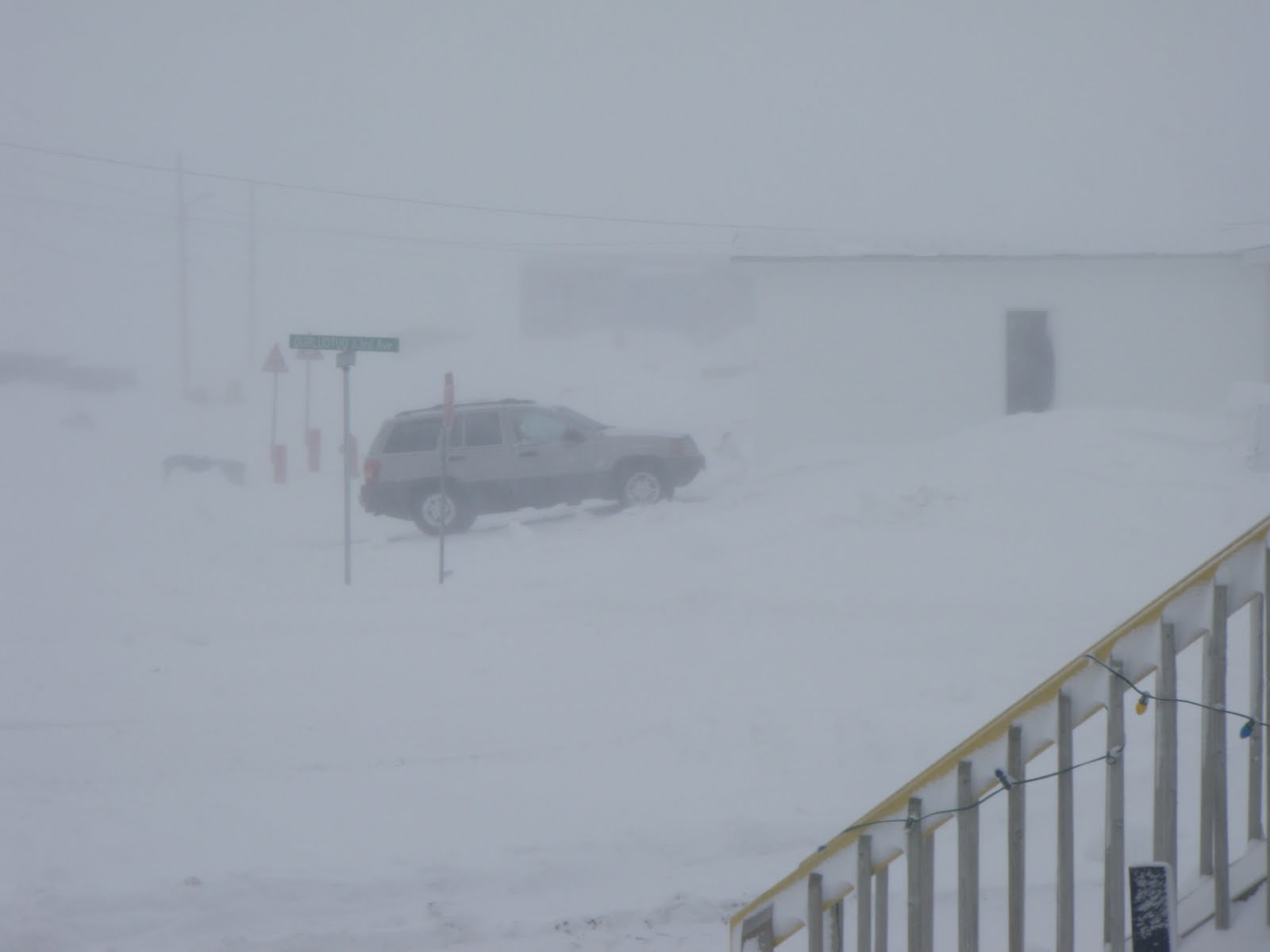
Life in the north involves blizzards!! They happen. The definition seems to be somewhat vague but usually involves low temperatures, low visibility, strong winds and blowing snow. Accumulations may not be big, but the blowing makes all the difference.


There are also Winter storm warnings. Not sure what the diffference is. The weather report at weatheroffice Nunavut (using google search engine) said that Monday March the 29th was a winter storm warning day. It was beautiful. The skies were deep azure and there were not clouds. Photos were taken. It is amazing how quickly things can change.

This was also the day that one of our patients developed high blood pressure. She was in for a regular 35 week appointment and her blood pressure was 152/98. Not terrible if you are near an obstetrician or a hospital. We had neither of these. Winnipeg was phoned. We were told to recheck it that evening and if it was still that high to medevac her out. If not she could take a sched (scheduled flight) the next day.


I went to take her blood pressure early that evening. It was down slightly 148/96, but it did not matter. We were in the beginnings of a blizzard and there were no planes leaving.

Walking to her house was difficult. She lived on one of the few roads that does not connect to main roads, so although she was only a block away as the crow flies, it was about 4 blocks to walk it. The winds were 60km an hour at this point.


Tuesday conditions were slightly better. We went to work, and waited for the e-mail that would tell us to leave work. We cancelled all our babies, as most of the Mum's walked to appointments with their babies in their amoutiq's. Work was not cancelled, but we did wonder how we were going to get home that evening. Road conditions were terrible.


That night there was a birth, and I was second on call. The first on call did not call me. Conditions were terrible. A nurse was sleeping at the health centre and she had obstetrical experience. The first on call midwife had to go and pick up the clients, from a bed and breakfast as they were from a Kivalliq community and not Rankin Inlet. She could not drive into the health centre because the drifts were so bad, and ended up parking at her own home and walking with the woman, her husband and three year old to the health centre. The baby was born less than an hour later.


The next morning I looked out the window and waited for a phone call. Usually they come before 8am saying that work is cancelled for the day. It did not come. Looking out the window I could see about three houses away. The blowing snow was phenomenal. We had no front stairs to our building because the drifts had covered them. Went outside to go to work. I had been advised to walk as the ploughs had not been through.


This week I was taking care of Mitzi, one of the midwive's Norwegian Elkhound puppy, and her house. Went there to make sure she was okay before work. Of course she had managed to wind her chain through the wood of the small porch and was now had the freedom of only about 18 inches of chain. I had to find a knife to push through the slats to free her. Then gave her a treat. And now the ploughs were going through. Figured I could drive to work.


This morning one of our midwives and the maternity care worker were to be at the school for a job fair. Our supervisor was taking a management course at the health centre, and I was to be the only person at the "wellness centre" to manage whatever patients walked in. Wednesday is an administration day.


I picked up the maternity care worker and we drove to the wellness centre. Roads were awful. Snow was flat and you could not tell where many of the drifts were, and many of them were eighteen inches deep. Ploughs had only done one lane on some of the roads, and none on others. You could not pass and at certain intersections you could not see what was coming.


We got to the wellness centre to find that the fair was cancelled, and so were the schools. As a result the midwife had to stay home and look after her 4 and 6 year olds. We also realized that I needed to go back to the health centre to pick up some paperwork. So, we tried again. Roads around the health centre are the worst in town. The wind blows off the sea ice and visibility is really poor, and the drifts are also bad wherever there is any protection at all, as in from the snow piled at the sides of the road. We did make it there, and then chose to drive around town (silly when I look back at it now) and take some pictures.


div>
We got back to the wellness centre about 30 minutes later and did do some work. It was obvious to everyone that it was just a matter of time before the e-mail message came that day. It finally did at 11:15, just announcing that Rankin Inlet government offices were closed until further notice.


Our high blood pressure lady lived very near the health centre and she went there about 10:30 to have her pressue checked. It was again high, but not as bad as it had been. However, she had some protein and some visual disturbances. Basically, there was nothing we could do.


We did get home, and spent the afternoon watching tv, playing facebook, cleaning. That night was stitch and bitch and conditions were somewhat better, in that you could walk, but not drive. Walked to the neighbours house and we had a very nice evening stitching and talking.


The next morning we again waited for the phone call that did not happen. Schools were also in this day. We needed to do a home visit on the woman who had birthed, and again cancelled all out postpartum visits so mothers would not have to walk in. I believe two women were seen that day, at 10am. Two of us went to do the home visit. We could not see driving. Visibility was bad enough that you could only see across the street, and not during gusts. With both of us looking out the car windows we could not see everything coming, and we could not see the drifts. The car that Birthing drives is called the Shitara, as it is older, and small. It made it to the bed and breakfast and back. While there though, we were phoned to tell us that it was now a blizzard day, and the wellness centre was being closed. It was 10:15.


I was on first call, so would need to walk to the blood pressure woman and check her, if conditions got any better. In the afternoon they did for a short period of time, so I walked to her house. I knew the short cuts, but it was still amazing getting there.


In Rankin, you can see where the drifts are, if visibility allows, or you are walking. What you cannot tell is the texture of the snow. You can walk across a drift and not sink into it at all, because the snow is so firm, and suddenly go down to your hip as the texture has changed. It is quite fun, if you are dressed adequately, and not in a rush.


Conditions improved over the next couple of hours, and the storm was supposed to end, and be followed by a very nice Easter weekend. I was going to go out on a dog sled to a cabin, with an igloo and sleep Friday night in the igloo.


By Thursday night, provisions in town were getting low. There was no milk in the stores, and no vegetables, but these were not as missed as milk.


Friday, Good Friday, the sun rose beautifully. Extra flights were put on. Our lady went out (and had her baby the next day. Often flying here seems to put women into labour), and I phoned about timing for dog sledding.


The weather forcast had changed. Now Friday was to be good, but a winter storm warning with high winds was to come up on Saturday. Our options were to go on Friday and plan to come back Sunday. We could wait and go Sunday and come back Monday. Or if the worst came we could go on Monday and come back Tuesday. I knew right away the latter would not work as the call schedule would not allow it.


Luckily we chose not to go. By Friday night we were in another blizzard. We did go dog sledding to exercise the dogs in the afternoon, and it was lovely, but conditions here change so quickly that there was no visibility and heavy winds by Friday night.


As it turned out we had another blizzard from Friday night til Monday morning. It was a very good thing we did not go out. However, conditions were good enough on Friday that several freight flights were made and the town was restocked.

/div>It was lovely to be able to have coffee with cream again, during the second blizzard.


One of the discussions that newbies have soon after arrival here is what to do during a blizzard. The general concensus is...stay home. Do whatever you can at home, but don't go out. We actually had a good time during these two blizzards, because although conditions were bad, you could see far enough...one house, that it was safe to go out, if you were not going too far, and stayed on the roads. We watched dvd's and movies, knitted, crochetted, read and used our computers. It's no wonder that everyone likes blizzard days...occasionally.


Thursday, March 18, 2010

Churchill


Churchill is a place I have always dreamed of visiting. It really is part of my "bucket list", must sees before I leave this planet!. And it is one dream that has finally come true.

Who can resist the allure of this small town. The polar bear capital of the world, a northern town, almost in the Arctic, where there is sea ice. Whenever there has been talk of this small northern Manitoba town I have been fascinated.

The dream however, is a little different from the reality.


Churchill has about one third the population of Rankin Inlet, 900 compared to 2800. It is obviously a tourist town, and has many hotels, motels, and bed and breakfasts. All the street signs are polar bears. There are many attractions, including the Eskimo Museum, the Train museum, souvenir shops selling carvings, tuftings and clothing, and hockey. (Hockey is an attraction in all northern towns, and one of the activities that draws the towns together.)


I arrived in Churchill on Saturday morning, and checked into my hotel at 2am. A little late, but that is when the medevac plane had arrived and been put away. The airport is about 6 miles from the town. It was part of the old army/air force base. That is known as Fort Churchill and it seems that not much of it is still in use, or even there.

When you arrive from the North, the great thing about Churchill is the trees. It is also an amazing part of the landscape if you arrive from the south. Churchill is just south of the tree line. There are trees. They are short, often have branches on only one side, because of the wind, and are often hundreds of years old. Locals tell me that Inuit children arrive and are in awe of the "tall" trees. People from southern climes are also in awe of the trees, but more because of their survival, and shape.


On a number of flights to and through the aeroport, I have met and seen a number of tourists going on eco tours in Churchill. Have looked up some of the available tours, just to see when and how I could do one. They generally guarantee that you will see bears, whales, seals, wolves, and various other wildlife. (This is the one aspect of northern life that has escaped me. So far have seen various birds and siksiks in the summer, and in the winter, Ravens and Arctic Hares.)


Many of the tourists have talked about the polar bear jail. Churchill is well known for it. This is an old Quanset building near the airport, and not a tourist attraction. Tourists are not allowed to visit it. I was also told that the bears are not fed while there, because they are caught during their "lean times". They can be there for a month, and are flown by helicopter to new locations when it is time. From reading I understand they are also marked so if they arrive too many times, more drastic action can be taken.


There are many rumours about polar bears. One of the Midwives talks about how a polar bear, when she was working in Churchill, killed a young man. You hear that they are the only animal that will hunt and stalk man. You also hear that they avoid man. (I do know that when we went to Marble Island, the tour guides carried rifles to keep bears away.) Whether polar bears are a menace to man seems to be unknown. Obviously if you get between a mother and her cubs, there is a problem. It is not a good idea to be out walking where there are bears, and they warn you of this on walking trails in this town.


Check out time at the hotel was 11am. I was actually quite tired. On Friday had worked the usual 8:30-5:00 but had been called about 4:30 and then worked until plane landed at 2am. It had been a long day. The hotel had arranged for a ride for me to the airport at 19:00. Luckily the clerk knew the airline schedules. She phoned and we found out the plane actually left at 18:00, so they changed my ride time. She also mentioned that I should go to the Trading Post, down two blocks. We then talked about the polar bear in the lobby. It is standing upright, and HUGE. She said that while she was on a recent vacation it had been damaged. The claws of one front paw had been taken out and the other paw had been cut and was now hanging. Poor bear.


I went to the Trading Post. Quite an amazing souvenir shop with lots of Inuit carvings, books, clothing, including kamiks and slippers and boots of all kinds, but not many of the cheap souvenirs you find in normal stores. I was totally surprised at the price of the carvings. This is just out of the north and prices were 5-6 times what they were in Rankin. However, they did have some hand towels with dog teams and polar bears on them that I did purchase. Next I walked along the main street, and in the middle of town came to some welcome to Churchill signs. It seemed surprising that they were here, until I realized that most people arrived in this town by train. From here you could also see the Port building. All the boats travelling to northern hamlets leave from this Port, so quite a bit of freight travels through here.


The train station was in the middle of town. So, my next walk was to the Train Station museum. This is a national historic site. That means government hours, and not open on the weekend. I do wonder how a site that makes it profit, or loss, on tourists would not be open on weekends, except of course, it is the slow season and winter. Turned out there was a hockey tournament in town this weekend, though, and that I was lucky to have a room. The town was completely booked up!


Next was lunch. The desk clerk had said there were about three restaurents open in town. The plane crew, who were stationed there, told me about two. One was in the hotel I was staying in and the other was down the street. I headed down the street, and had a lovely salad. Then headed for the Eskimo Museum.


Again, I realized it was the off season, and a weekend. The Eskimo Museum was not open until 13:00 and I was a few minutes early. Decided to walk up to what looked like an old building. Turned out it was actually a new outbuilding of some kind, but it was on snowmobile and walking trails. Really they were not walking trails though because this is where I encountered the "Polar Bear Alert" signs, and I could see that they were every hundred feet or so along the trail. Oh well, back to the Eskimo Museum.


This is a museum that is worthwhile for anyone to see. There were children there, and adults and all seemed to be enjoying it. Mostly it is showing the history of the Inuit through their carvings. Of course, some of them were hunting scenes, and some were the ends of harpoons and fish harpoons. It was VERY interesting. They also had some sculptures depicting scenes, which were likely made in Rankin, as this is the area where pottery was developed, and that only since the 1970's. In the area of the gift shop they again had lots of small carvings. I had already purchased similar small carvings in Rankin but the prices were about 4 times higher in Churchill.


I walked around town. Had been told to go to the "Centre". It is actually the area where the hospital (10 beds), the school and the shops, other than groceries were. Really about four small stores, including the liquor store, in one small building. After wandering around this area and recognizing how much better the housing and store construction were than further north I headed back to the hotel. Was exhausted and decided that a cup of tea was in order. Went to the hotel cafe and had a veggie burger and tea. Read my book and then paid, bought a scratch and win (which are not available in Rankin) crossword and went back to the lobby. Scratched my ticket and won $5, so went back to the cafe and got $2 and another ticket. Went back to the lobby and scratched. I won $10 this time, so back to the cafe and got $7 and a ticket. Back to the lobby and scratched. Won $20. Back to the cafe and picked up $17 and a ticket. Back to the lobby and did not win. So read my book until my ride came. He was early because he had boxes that had to be checked in at the aeroport. That worked out well for me. The caffeine in the tea was just kicking in and I was waking up.


We drove to the aeroport, and he pointed out the bear jail to me. There is a small sign on it with a bear behind bars, but since tourists are not allowed near, there is no other indication of what this large quanset building is. The terminal building has a display of a few artifacts from the area. There are pictures of Fort Churchill. One artist called "We are Bears" sells nice polar bear jewellry when the flights come in. And they put out coffee and sometimes cookies for passengers who are waiting for flights.


As we were taxiing there was a beautiful sunset...starting pink and then a beautiful full red. It was a lovely end to the day in Churchill.


Global warming is definitely having an effect in this area. Several times I heard comments and worry about the warm temperatures. It was actually slushy while I was there, and that was early March. The locales were concerned about the number of bears that would be coming in, and that they would be coming much earlier than usual. As we flew over the Hudson's Bay there was open water very close to the shore. Bears hunt from the edge of the floes, and if they are close to any town they will come in to the garbage dumps. (I am told by the Inuit that you can tell from pictures, where bears are from. If they have a yellowish tinge you know that they are from near Churchill, because they are eating garbage and now seals. If they eat mostly seals they are much whiter, and the whitest, in pictures are usually from Repulse Bay or north of the Arctic Circle).

Saturday, March 13, 2010

A Medevac Trip


Friday I was on first call.


One of our women went into possible labour at 35 +6 weeks. She had to be medevaced out. As the flight nurse was not sure if the woman would deliver on the plane or not, she asked for a midwife to accompany them. Our supervisor said yes, as there were five of us last week, and I was on my way. When there is a possibility of a birth, the flight nurses ask for a midwife or a second flight nurse to accompany them. (For anyone who has not been reading my previous notes you will need to know that a hospital is usually about 3 1/2 hours away in Winnipeg. As this baby was unlikely to need a NICU the client would be able to deliver in Thompson. Everybody who goes into labour prior to 37 weeks has to be assessed and if time permits, sent to a hospital with obstetrics, for delivery. Usually the women here deliver very quickly, so there is very often not time to send them "out".)

It turned out that this particular flight was coming from Baker Lake, with a patient for Rankin. (Now that we have four inpatients at Rankin, the hospital takes patients that need observation. They hope that the ten bed ward will eventually be fully open.)

The flight crew, on the medevac plane was based in Churchill, so I had been told that I would go with them, and our patient, to Thompson, Manitoba, and then we would fly to Churchill, and I would spend the night there. I considered myself very lucky that they booked me a hotel room. They also phoned me and told me how to contact the night clerk, as we would not arrive until at least 1am and the hotel was closed prior to that.

The flight nurse arrived, and our lady in labour was having fewer contractions. For all you midwives reading this, we now had a baseline fetal heart rate of 175-180. The client was unhappy about having to go to Thompson, but as we watched the baseline climb from 140 to 180, we were very glad we had organized the medevac.

Medevac planes are small. As you can see from the photographs with this post, there is room on one side for the flight nurse, and two other people, often another flight nurse and an escort. On the "business" side of the plane there is a stretcher with the patient, and another stretcher, which could have a patient, or, as on this flight, a baby pod. If you look past the patient you see most of the back of the plane where the baggage and extra medical equipment is stored. In one of the other photos you can see the pilot and copilot. The patient is attached to a blood pressure cuff, an oxymeter, and an IV pump. They have lots of other equipment, so they can take all kinds of different traumas. This particular flight nurse was a trauma/ER/ICU specialist. We had lots to talk about on this particular flight.
We left Rankin health centre at 19:00. We arrived in Thompson about 21:30. A proper ambulance picked us up. (In Winnipeg we get met by a private ambulance service.) The firefighter who was driving had a fair bit of information about the city. The population is 15,000. It has most of the facilities of a larger city, as it is the largest centre of northern Manitoba.
A medevac team is on the ground for 2 1/2 hours at the most. We went to the hospital, watched the nurse start an NST and admission, the flight nurse did a bunch of paperwork, we said good-bye, and left. The cab took us to TIM HORTON's. It was lovely, a sandwich and a decaf. Back to the aeroport. Apparently things changed re: where the flight crew went. The nurse was just back from her "time south" and did not know that they were using a different area of the terminal. We spent half an hour trying to figure out where we were supposed to be, being found by the co-pilot, and boarding the plane. It was only an hour to Churchill. (No wonder they did not want to take me the two hours back to Rankin and then go to Churchill. More important they would have timed out. They are only allowed to fly a certain number of hours.)
At Churchill the flight team had to get the plane into a hanger, and reload and unload medical items. It was REALLY interesting. The hanger already had a plane in it, and a large, unlicensed, Suburban type vehicle. It turned out this truck was to pull the plane!
The hanger doors went up. The pilot pulled the plane into the hanger. The doors were closed. The oxygen was checked. The baby pod was removed (as it belonged in Rankin and not in Churchill) and we got supplies onto the plane. The team then drove me into Churchill, and told me all the good things to see.
My flight the next day was not until 18:00 so I was able to do something else on my bucket list. I had always wanted to explore Churchill Manitoba, and thanks to the medevac, I was going to have this dream come true.